I Was Terrified to Ask Her for Help — Until Fear Turned Into Respect for Each Other
Have you ever had one of those days — a hard, urgent situation with a patient — where you needed help from someone else?
Maybe you worried you'd get pushback. Maybe you had to dig deep just to advocate for what your patient needed. What if they don't agree? What if they don't help?
Ugh. Hard.
G.R.
I had a young patient, G.R. — a 27-year-old man living with his family in a small apartment.
He had metastatic lung cancer with severe pain. He was very weak, and in bed most of the time. The tumor had grown large enough to press on his esophagus, making it impossible for him to take enough oral opiates to give him relief.
G.R. still had a port-a-cath in place — but it wasn't being maintained. At the time, I wasn't experienced enough yet as a hospice nurse know to get orders to reestablish its patency before things reached this point.
So now, it was urgent. A home infusion nurse needed to see him that day to get the port patent to start IV opiates.
I was on a mission.
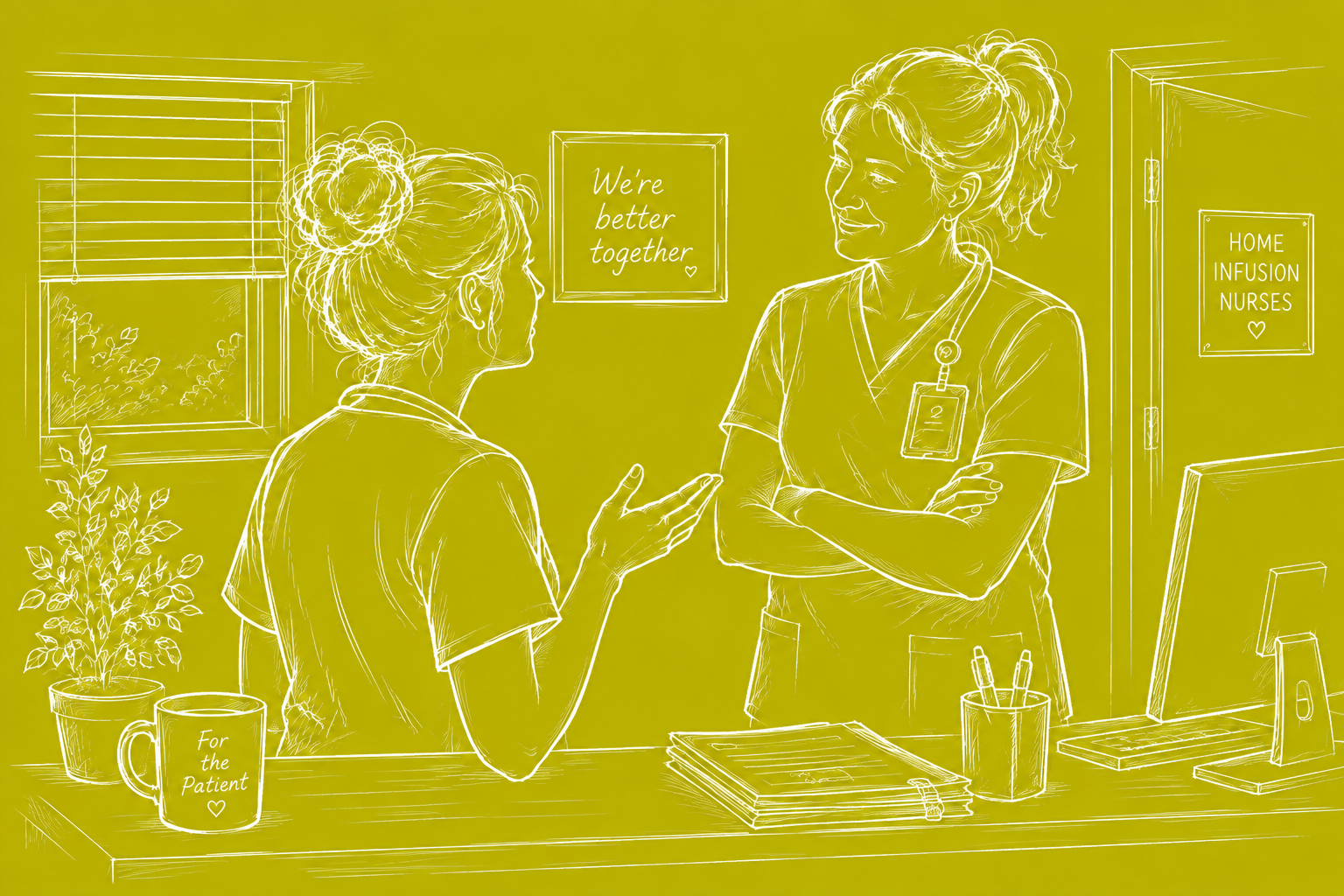
The Force to Be Reckoned With
I made a beeline back to the hospice and home infusion office to talk to the home infusion nurse supervisor — I needed that home infusion nurse visit scheduled immediately.
A little backstory: the home infusion nurse manager, K.S., felt like a force to be reckoned with. She may have been six feet tall. She had a commanding presence. Honestly? She intimidated me.
But for my patient, the intimidation didn't matter. All I could think was: we need a nurse out there today.
When I arrived, I spoke first with the home infusion pharmacist — a kind man, eager to help however he could. Then K.S. came over. She was reluctant to promise anything. She needed to know more.
I told her.
She wasn't sure she could get a nurse out there that day. I made the case — respectfully, but firmly — for why it had to happen. Why it couldn't wait.
She agreed. She'd get a nurse out there and take care of the opiate orders.
Hmmm, was more conversation needed?
The next morning, on my way to work, I couldn't stop replaying the conversation.
I hadn't had many exchanges like that before. Had I pushed too hard? I still believed in what I'd asked for — but the doubt crept in anyway.
When I got to the office, I went straight to my manager and told her the whole story. I asked if I should go back to K.S. — thank her again, and be clear that my insistence came from how worried I was about my patient's pain, not from anything personal.
My manager thought it was a great idea. She pointed out it might even strengthen the working relationship between hospice and home infusion going forward.
Closing the Loop
I went straight to K.S. and asked if she had a minute. She did.
I thanked her for getting a nurse out to my patient the day before. I told her my insistence came from how much I cared about his pain. I told her how much I respected her — and that I could never do what she does.
She thanked me. Then she said the same thing back to me: she could never do what I do.
We parted with a smile each.
After that, everything changed. I was no longer afraid of her — only full of respect. And I could feel that she respected and trusted me too. I don't know exactly how much that moment helped my hospice team overall, but I'm confident it didn't hurt.
Have you had a similar experience? I'd love to read about it in the comments below.
A Note on Authorship & AI
The ideas, stories, experiences, and primary content in this article are written by the author. AI tools may occasionally be used for minor editing, such as grammar, clarity, or organization. AI is not used to generate the author’s stories, experiences, or original perspective. All final content is reviewed, revised as needed, and approved by the author before publication.