When Doing Everything Doesn’t Feel Right
There are moments in nursing school and early in our careers that stay
with you always, right?
“Always be thinking about preventing infection.”
“Protect the airway.”
“Follow best practice.”
You learn the standards and practice them.
Eventually, they become second nature.
Until…
One day they don’t fit the situation right in front of you.
And that’s when things can get complicated.
The Question We Never Want to Ask
If you’ve worked in hospice or palliative care for any length of time, you’ve
probably had one of those moments.
A moment when there wasn’t a perfect answer.
A moment when no “appropriate” options felt exactly right.
A moment when you might lay awake later wondering…
Did I do the right thing?
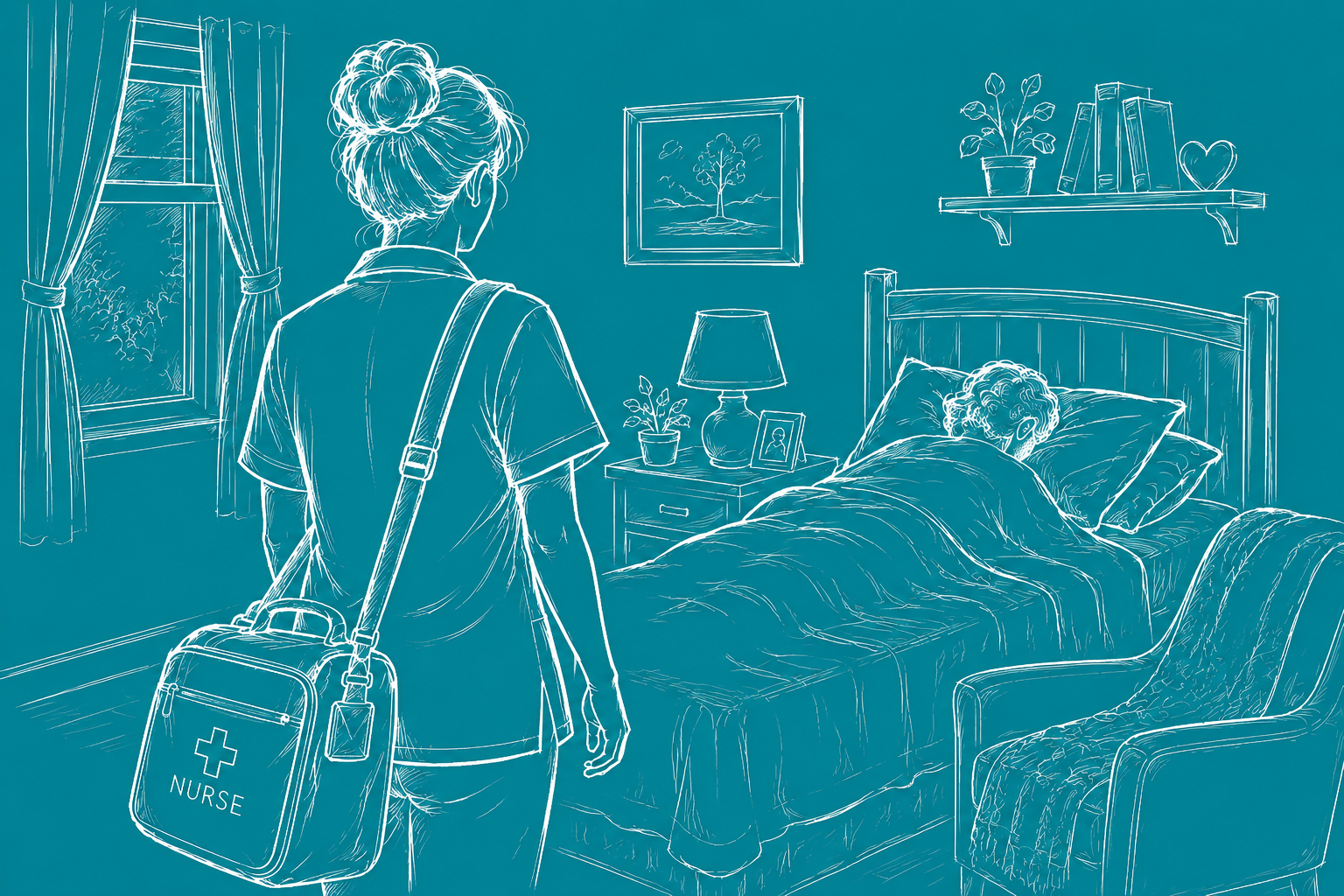
When the Textbook Answer Doesn't Apply
Wound care in hospice is a perfect example.
Most of the time you know exactly what to do.
Often in hospice, there are adjustments, with the goal being comfort instead of curative.
The best you may hope for is keeping things clean.
Sometimes, your best may not seem like it.
“Clean Technique”
“Assess if the wound care procedure is still appropriate.”
“Watch for infection - possible source of pain.”
You do these things naturally. They become second nature.
And… some hospice patients’ wounds may not respond to the above.
Sometimes the wound is in a place that can never stay clean.
Sometimes the dressing changes are painful even if your patient is
premedicated.
Those are the times that test you
Because the question isn’t…
“What is the perfect answer?”
It’s…
“What is the safest and kindest answer?”
A Patient I Will Never Forget
Years ago, I cared for a young man with advanced head and neck cancer.
I was working as a hospice nurse for a large home health, palliative care,
and hospice program.
Occasionally I was asked to see palliative care patients.
This young man was one of them.
Clinically, he was ready for hospice.
Emotionally…
He and his family needed more time.
I was his nurse and got to know him and his family, and support them
on his palliative care journey, and through hospice, to the end of his life.
The Impossible Decision
By the time I met him, the cancer had dramatically changed his
appearance.
He could no longer eat or talk.
His wife lovingly managed his feeding tube.
A tracheostomy had recently been placed.
Then there was the wound.
The cancer had eroded through the tissues of his neck and jaw.
It was large.
It was draining.
It was the second thing I noticed, after his disfigurement.
As the disease progressed, the tracheostomy ties were getting soiled,
being so close to the wound.
With that, each dressing change became more difficult.
One day I found myself staring at those trach ties.
They were soiled.
They smelled… bad!
Everything inside me wanted to replace them.
Right?
But I didn’t think I could safely remove the soiled trach tie and thread a
clean one back through the eyelet of one side of the flange of the trach
tube. It was positioned in the wound, in a way that I couldn’t change it
without risking the positioning of the trach tube.
Doesn’t a good nurse do everything she can to keep things clean, like
change soiled trach ties?
I just stood there for a moment.
Thinking.
Calculating.
Worrying.
This wasn’t in any policy manual.
There wasn’t a class in nursing school called, “When No Choice Feels Right.”
Asking for Help
I needed help.
I arranged a conference call with my manager and the clinical nurse
specialist, who was certified in wound care.
I described exactly what I was seeing.
I explained my concerns.
Then I asked the question every nurse hopes someone will answer in a
kind supportive way, regardless if it is “Yes” or “No”.
“Am I doing the best that can be done?”
Their response was immediate.
They trusted my assessment.
They believed I was making the safest decision possible under impossible
circumstances.
The clinical nurse specialist didn’t feel she needed to visit.
She felt confident that I was already providing the best care in this tragic
situation.
I cannot describe the relief I felt.
Not because the situation became easier.
It didn’t.
But because I wasn’t carrying the weight of that decision alone.
The Intervention I Needed Most
Looking back now, more than a decade later, I realize something.
The most valuable intervention that day for this patient (and for me!)
wasn’t another procedure or protocol.
It was support.
Professional support.
Emotional support.
Someone in authority at work saying,
“I trust your judgment. You are doing the right thing.”
Those words matter more than we sometimes realize.
What If I Had Been TRULY Alone?
I often wonder what would have happened if I didn’t get that support.
Would I have second-guessed myself every visit?
Would I have carried unnecessary guilt?
Would I have reached out to coworkers?
Would I even have known who to ask?
I Would Love To Hear Your Story
Have you ever been there?
Have you ever faced a situation where “best practice” simply wasn’t
possible?
Where you had to choose between imperfect options?
Where compassion and clinical judgment are called for, and the answer is not optimal?
Those moments define hospice and palliative care nursing.
They also remind me that no nurse should have to make those decisions in
isolation.
My hope is that every hospice and palliative care nurse has access to the
kind of support I received that day.
Because sometimes the hardest part for hospice and palliative care nurses
isn’t the details of a complicated situation that has no good options as the
one my young patient had.
Sometimes the hardest part is wondering whether you’re making the right
decision.
And wondering if anyone has your back.
I’d love to hear your story.
Have you ever found yourself in a situation where there was no perfect
answer?
Did you have the support you needed?
Or were you left to carry it alone?
I pray you will always have the support you need in these really hard situations.